PBIAA Swansea Event
24-06-2026
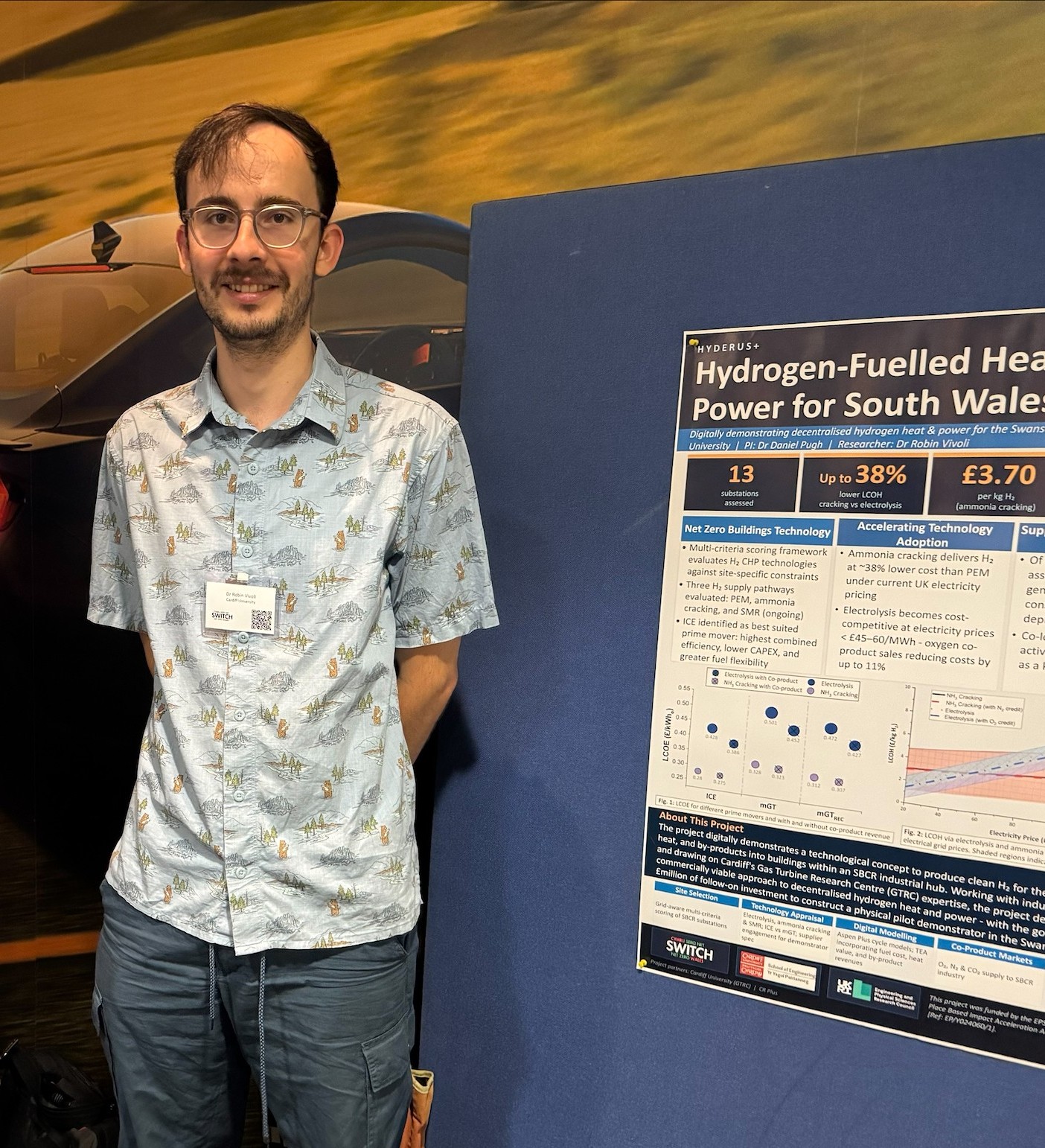
On a very hot day indeed, Drs Tony Giles and Sally Hewlett accompanied Dr Robin Vivoli to the Switch to Net Zero Buildings (SNZB) Showcase Event at the Swansea.com Stadium for the presentation of his HYDERUS+ poster. It was a great opportunity for the team to see all the presentations and posters arising out of the SNZB Place Based Impact Accelerator Account.
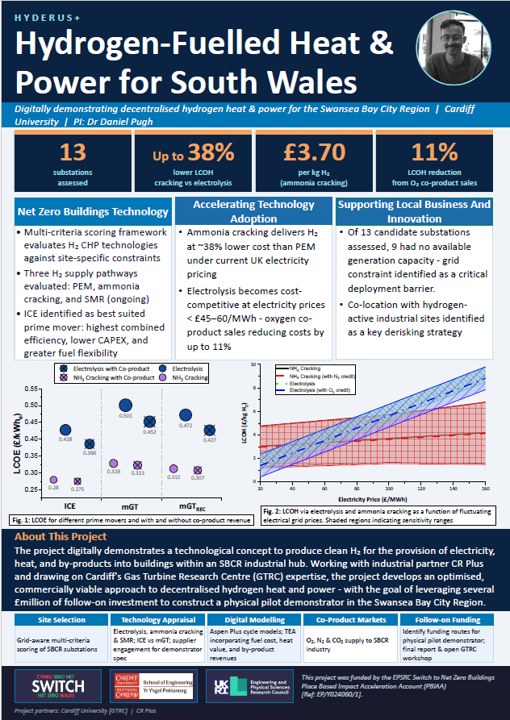
A core challenge for HYDERUS+ is improving the commercial viability of local hydrogen systems - and our latest study digs into exactly that.
We carried out a techno-economic assessment of modular, locally produced hydrogen-fuelled combined heat and power (CHP) systems, comparing three supply routes: electrolysis, ammonia cracking, and steam methane reforming (SMR) with carbon capture. Using detailed Aspen Plus process modelling, we assessed how by-product valorisation (oxygen, nitrogen, and CO₂) and energy storage strategies affect overall plant economics - directly informing the approach HYDERUS+ will take.
Key findings:
- Ammonia cracking currently offers the lowest levelized cost of hydrogen in the UK, driven by feedstock cost rather than capital or electrical intensity
- Electrolysis becomes cost-competitive with cracking when grid electricity prices fall below roughly £45–60/MWh
- Small-scale CHP plants are unlikely to run continuously - and reduced operating hours (down to 2,000 h/yr) bring substantial cost penalties, most severely for SMR
- Mitigation strategies such as hydrogen buffer storage, off-peak electricity coupling, and thermal/electrical energy storage can recover up to 15% in costs, with the most effective approach depending on the supply pathway
| RENEW Project Start 01-09-2026 |
| PBIAA Swansea Event 24-06-26 |
| Visit from Cranfield University CDT Students 06-05-2026 |
| Switch to Net Zero Report 14-05-2026 |
| NGT Variable Blend Project Conclusion 23-04-2026 |
| Dr. George McPherson viva success 16-04-2026 |
| Paper Publication - Reporting NOx 07-04-2026 |
| Dr. Ben White viva success 11-02-2026 |
| Dr. Elliott O'Malley viva success 27-01-2026 |
| Dr. Robin Vivoli viva success 12-12-2025 |
| Dr. Jordan Thomas viva success 05-12-2025 |
| GTRC Welcomes New Research Associate Robin Vivoli 25-11-2025 |
| Social Construct visit 19-11-2025 |
| HYDERUS+ project started 12-11-2025 |
| Ben White starts role at CRPlus 10-11-2025 |
| NGT Blending Project Started 03-11-2025 |
| Elliott O'Malley begins new role with BAE Systems 06-10-2025 |
Copyright 2007-2020 Cardiff University - Gas Turbine Research Centre :: Privacy Policy :: Terms of Use